


It is the ultimate airport nightmare: you are waiting at the departure gate, your boarding pass is in hand, and your suitcase has already vanished down the check-in conveyor belt. Suddenly, the flight status board flashes red: CANCELLED. Amidst the immediate scramble to rebook your travel, an urgent question takes over: Where is my luggage? When a flight is cancelled, your suitcase is already deep inside the airport’s secure automated baggage system or loaded into the aircraft’s cargo hold. Here is the definitive 2026 guide explaining what happens to your checked bags, how to retrieve them, and your legal consumer rights under international aviation law.
1. Where Does Your Luggage Physically Go After a Cancellation?
Once you hand over your bag, it travels through miles of underground conveyor belts to a sorting facility, eventually grouped by flight in a secure holding area. If your flight is cancelled, the physical location of your bag depends entirely on the timing of the announcement:
- Before Loading: If the cancellation occurs early, your bag remains in the secure airline holding area or sorting facility. It is flagged in the system to be offloaded and routed back to the airport's baggage claim area.
- After Loading (On-Tarmac): If the flight is cancelled while the aircraft is on the tarmac, ramp agents must manually unload all cargo containers. This process takes time, as the ground crew must coordinate with air traffic control and wait for the plane to return to a gate.
- Mass Disruption (System Outage/Weather): During major storms or IT outages, airline ground crews are overwhelmed. In these scenarios, bags are often moved to a secure holding room at the airport rather than returned immediately, to prevent gridlock.
2. The 30-Minute Emergency Protocol: What to Do First
When the cancellation announcement is made, time is your most valuable asset. Do not panic; follow this structured 30-minute protocol to protect your belongings:
- Step 1: Check Your Rebooking Status. If the airline automatically rebooks you on a flight departing within a few hours, they will typically transfer your bag to the new flight. Verify this with a gate agent or check your airline app's baggage tracker.
- Step 2: Locate the Baggage Service Office (BSO). If you are not traveling today, or if you are switched to a different airline, your bags must be returned to you. Head directly to the airline’s Baggage Service Office near the baggage claim carousels — do not stand in the line at the ticket counter upstairs.
- Step 3: File a Property Irregularity Report (PIR). If the airline cannot immediately locate or return your bag, demand to file a PIR before leaving the airport. This document is your official proof of a delayed bag and starts the tracking clock.
- Step 4: Keep Your Baggage Claim Tags. Do not lose the small barcoded stickers stuck to your passport or boarding pass. They are the only legal link between you and your suitcase.
💡 Insider Tip: Can the airline send your luggage without you? Yes. If you are rebooked on a later flight or cancel your trip entirely, the airline may still fly your bag to the final destination on a different flight for logistical reasons. Always file a report to instruct them where to deliver it.
3. What Should You Do If Your Flight Is Cancelled After You’ve Checked Your Bag?
If your flight is cancelled after checking your bag, immediately verify if you are rebooked. For same-airline rebookings, your bag is usually transferred automatically. If you are cancel-checking or switching airlines, proceed directly to the airline’s Baggage Service Office near the baggage claim carousels to request physical bag retrieval.
4. Passenger Rights: The Montreal Convention & Transport Rules
Under international law, you are not helpless. Your rights are governed by strict global treaties and local transport authority guidelines:
The Montreal Convention (International Flights): According to the International Civil Aviation Organization (ICAO), the maximum liability cap for baggage delay, damage, or loss is strictly set at 1,519 Special Drawing Rights (SDR) per passenger (equivalent to approximately $2,030 USD / $2,780 CAD). Note that this is not an automatic payout; passengers must submit a formal claim with itemized receipts to prove the value of their lost or delayed items. Depending on the applicable passenger-rights regime and the circumstances of the delay, you may be entitled to reimbursement for reasonable and necessary expenses.
U.S. DOT Baggage Rules: Under the U.S. Department of Transportation (DOT) consumer protection rules, airlines are required to refund your checked baggage fee automatically if your bag is significantly delayed (longer than 12 hours for domestic flights or 15–30 hours for international flights).
European EU261 & Montreal Convention Distinction: While EU Regulation 261/2004 provides passengers with fixed compensation and care for flight cancellations (as outlined on the official EU Air Passenger Rights Portal), it does not govern baggage compensation. Instead, baggage delays, damage, or loss on international flights are strictly covered under the Montreal Convention, requiring you to file a Property Irregularity Report (PIR) within 21 days for delays.
 Aerospace-Grade Aluminum
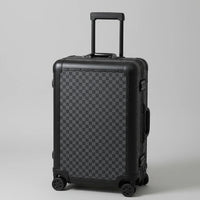
The Monarch — Aluminum Carry-On
Never worry about checked bag cancellations again. The Monarch Cabin is engineered to IATA guidelines to fit overhead bins perfectly, keeping your critical valuables by your side.
Shop The Monarch → Tracker-Compatible Compartment
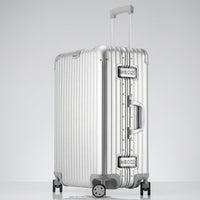
The Masterpiece — Legacy Aluminum Case
Features a rigid aluminum shell that allows seamless GPS/AirTag signal transmission. Track your bag's location in real time, even during mass airport disruptions.
Shop The Masterpiece →4. The Carry-On Survival List: What Must Never Be Checked
To protect yourself from cancellation chaos, your carry-on bag should act as a self-contained survival kit. If you are forced to check a larger bag, make sure these items remain with you in the cabin:
- Electronics & Power: Laptops, tablets, chargers, and external power banks (power banks containing lithium-ion batteries are legally forbidden in checked cargo holds anyway).
- Medications & Prescriptions: Always carry at least 3–5 days of essential medical supplies in their original packaging.
- Valuables & Documents: Passports, visas, car keys, cash, luxury watches, and jewelry.
- Disruption Essentials: A fresh change of underwear, basic toiletries (under 100ml), and a lightweight sweater or jacket.
5. Checklist: How to Protect Your Bag Before You Leave
A proactive approach before checking your luggage makes resolving a post-cancellation delay much easier:
- Use a Bluetooth Tracker: Drop an Apple AirTag or Samsung SmartTag inside your bag. Bluetooth trackers can provide additional location information through compatible device networks, often giving you visibility that airline baggage scans cannot.
- Photograph Your Suitcase: Take three photos of your bag (front, side, and open interior) before handing it over. If your bag goes missing, showing these photos to the baggage service desk speeds up identification.
- Remove Old Routing Tags: Barcoded stickers from past flights confuse sorting scanners. Peel them off to prevent your bag from being routed to the wrong airport.
- Upgrade to a Sturdy, Identifiable Case: Black nylon bags look identical in holding rooms. Carrying a distinct, rigid aluminum travel case with structural latches prevents accidental pick-ups and resists sorting belt damage.
Related Travel Intel
Frequently Asked Questions (FAQ)
Q: Can I get my checked luggage back immediately if my flight is cancelled?
It depends. If the cancellation occurs while the plane is still at the gate, ground crews will offload and return the bags to the baggage claim area (which can take 1 to 3 hours). However, during mass cancellations or weather delays, airlines may refuse to return bags immediately and instead transfer them directly to your rebooked flight or store them in a secure holding area.
Q: Can an airline fly my checked bag to my destination without me?
Yes. For logistical reasons (like cargo capacity and balancing weight), airlines frequently route checked bags on different flights. If you are rebooked on a later flight or choose to cancel your trip, your suitcase may still travel to your destination ahead of you. The airline is required to keep it secure in their baggage office until you arrive or arrange delivery.
Q: What is the compensation limit for delayed or lost luggage in 2026?
For international flights, the limit is governed by the Montreal Convention and is set at 1,519 Special Drawing Rights (SDR), which is roughly $2,030 USD / $2,780 CAD. This limit applies per passenger, not per bag, and covers reimbursement for essential clothing, toiletries, and supplies purchased while your bag was delayed.
Q: Does travel insurance cover delayed luggage during cancellations?
Yes. Most premium credit cards and travel insurance policies offer baggage delay coverage. If your flight is cancelled and your checked bags are delayed by more than 4 to 6 hours, your insurance will reimburse you for emergency purchases (often $100 to $500 per day) independent of any airline payouts. Keep all receipts and your official Property Irregularity Report (PIR).
Q: Can I track my checked luggage myself?
Yes, and it is highly recommended. By dropping a Bluetooth tracker like an Apple AirTag or Samsung SmartTag inside your bag, you can monitor its general location. Bluetooth trackers can provide additional location information through compatible device networks, often giving you visibility that airline baggage scans cannot.
Travel Intelligence for the Modern Executive
Control Your Journey. Pack Smart.
Explore Premium Cabin Cases →
Comments